Introduction
In today’s rapidly evolving business environment, the significance of artificial intelligence (AI) cannot be overstated, particularly for small businesses striving for efficiency and competitiveness. The integration of AI tools into business operations offers a myriad of opportunities to streamline processes, improve customer interactions, and ultimately enhance profitability. As small businesses look for ways to save time and reduce costs, the adoption of advanced technologies like AI becomes more crucial.
The current landscape of AI tools is vast and varied, encompassing everything from automated customer service solutions to advanced analytics capable of driving data-informed decision-making. These tools are designed to handle repetitive tasks, allowing small business owners to focus on core aspects of their operations, such as growth and customer satisfaction. The benefits of incorporating AI into small business practices are manifold, including increased productivity, improved accuracy in task execution, and enhanced scalability of operations. As small business owners navigate through tight budgets and limited resources, the strategic deployment of AI can serve as a game-changer.
This article aims to guide small business owners in making informed decisions regarding the adoption and utilization of AI tools. By examining various AI applications, their respective advantages, and practical implementation strategies, the article strives to equip business owners with the knowledge needed to harness the power of AI in a way that best suits their unique operational needs. Whether you are looking to improve marketing strategies, optimize inventory management, or enhance customer support, embracing AI technology can significantly revolutionize how you run your business in 2026 and beyond.
Understanding How AI Helps Small Businesses
In the contemporary landscape, artificial intelligence (AI) has emerged as a transformative force for small businesses, providing innovative solutions that enhance operational efficiency. By adopting AI technologies, small enterprises can significantly automate routine tasks, allowing them to allocate resources more strategically. For example, the implementation of AI-driven automation tools facilitates faster and more accurate responses to repetitive tasks, ultimately streamlining day-to-day operations.
Moreover, AI plays a crucial role in data analysis. Small businesses often struggle to harness insights from the vast data available to them. Through the utilization of AI algorithms, businesses can dissect large datasets to uncover trends and patterns, enabling informed decision-making. These insights can guide inventory management, pricing strategies, and customer segmentation, aligning operations more closely with market demands.
AI also enhances customer service capabilities, which is vital for small businesses aiming to compete with larger corporations. By leveraging AI chatbots and virtual assistants, small businesses can provide 24/7 customer support, addressing inquiries and issues at any time. This not only improves customer satisfaction but also reduces the operational load on staff, allowing them to focus on higher-level tasks that contribute to growth.
Additionally, AI technologies significantly boost marketing efficiency. Through AI, small businesses can tailor their marketing strategies by analyzing consumer behavior and preferences. Predictive analytics can be used to foresee customer needs, enabling targeted advertising and personalized content that resonates with the target audience. This level of customization enhances engagement and can lead to increased conversion rates.
Incorporating AI into various facets of business operations not only promotes better decision-making but also fosters enhanced productivity across the board. This strategic integration is essential for small businesses looking to optimize their performance and gain a competitive edge in the marketplace.
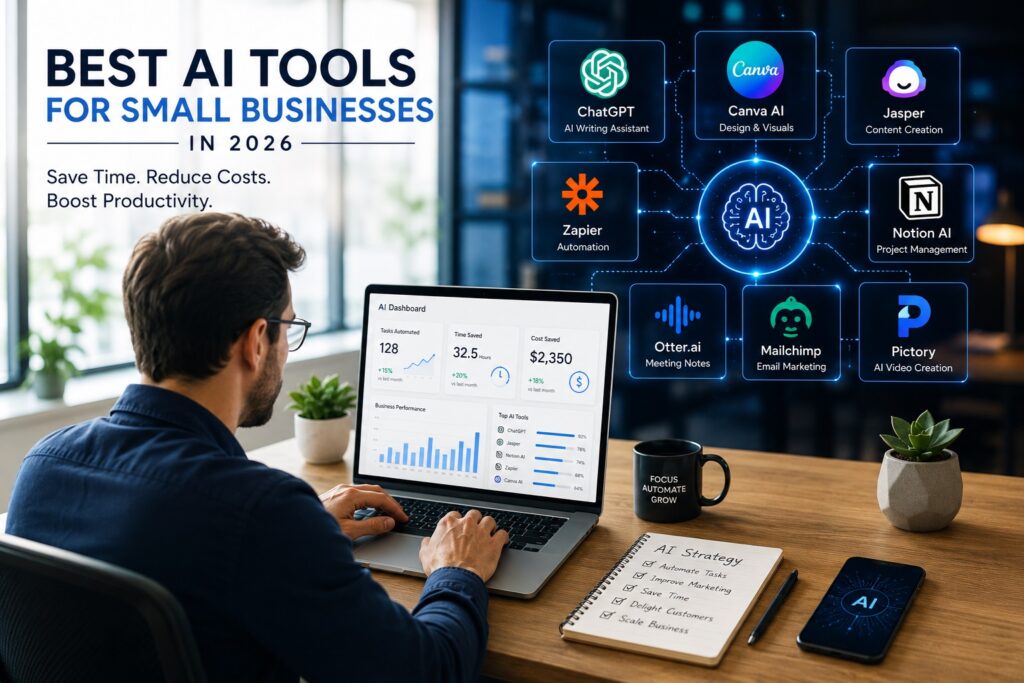
Top 15 AI Tools for Small Businesses in 2026
As small businesses continue to seek innovative solutions for improving operations, the integration of artificial intelligence (AI) tools has become paramount. In 2026, several AI tools stand out for their capabilities to save time, reduce costs, and enhance productivity. Here is a brief overview of the top 15 AI tools that small businesses should consider adopting.
1. HubSpot: A robust CRM platform that streamlines marketing, sales, and service operations through AI-driven insights, helping businesses optimize their customer engagement strategies.
2. Slack: This collaboration tool incorporates AI to facilitate communication among team members, managing workflows and reducing the burden of administrative tasks.
3. QuickBooks: An accounting software that employs AI to automate billing, invoicing, and reporting, thus enhancing financial management for small businesses.
4. Canva: A graphic design platform utilizing AI to assist users with designing visual content quickly and efficiently, perfect for marketing and branding purposes.
5. Hootsuite: A social media management platform powered by AI analytics, assisting businesses in scheduling posts and analyzing engagement across multiple platforms.
6. Trello: This project management tool uses AI to optimize task assignments and deadlines, ensuring teams remain on track and projects are completed efficiently.
7. Zoho: An integrated suite of applications that leverages AI to enhance productivity in sales, marketing, and operations specifically tailored for small businesses.
8. Grammarly: An AI-driven writing assistant that ensures communication is clear and professional by correcting grammar, tone, and style in real time.
9. Descript: This media editing tool utilizes AI to simplify video and audio editing, making content production more accessible for small teams.
10. ClickUp: A project management tool that incorporates AI features to improve team productivity and project tracking in a user-friendly manner.
11. Xero: AI-enhanced accounting software that automates bank reconciliation, reporting, and invoicing, streamlining financial operations for small businesses.
12. Salesforce: A comprehensive CRM that uses AI for data analysis, enabling businesses to personalize customer interactions effectively.
13. Mailchimp: An email marketing platform using AI to optimize campaign performance through data-driven insights, enhancing engagement and conversion rates.
14. Asana: A task management tool that employs AI to prioritize tasks and improve workflow among teams, allowing for efficient project completion.
15. Freshdesk: A customer support software that integrates AI chatbots to provide instant responses to customer queries, enhancing overall service efficiency.
These tools are exemplary in their functions, offering diverse features tailored to small businesses, thus presenting significant opportunities for growth and efficiency in the ever-evolving market landscape. In the following sections, we will explore each of these tools in greater detail, providing insights on how they can best serve small businesses seeking to thrive in 2026.
In-Depth Analysis of Each AI Tool
Artificial intelligence is revolutionizing the way small businesses operate. Below is a comprehensive analysis of fifteen AI tools that can enhance efficiency and productivity, helping small businesses navigate the challenges of 2026.
1. ChatGPT by OpenAI
ChatGPT is a conversational AI tool designed for customer support, engaging users with human-like dialogue. Its ability to understand context makes it superior in addressing customer queries swiftly. The starting price is free, with premium options available for businesses needing enhanced features.
2. HubSpot CRM
HubSpot integrates a variety of features, including email marketing and customer management. Its user-friendly interface makes it ideal for small businesses. Pros include its comprehensive analytics dashboard, while cons include limited customization. Pricing starts at $45 per month.
3. Jasper AI
Jasper is a content generation tool that assists in creating marketing materials efficiently. It stands out for its adaptability to different tones and styles. The main downside is its learning curve. Pricing begins at $39 per month.
4. Trello with Butler
Trello’s project management capabilities are enhanced by the AI Butler feature, which automates repetitive tasks. It is perfect for small teams managing multiple projects, helping to delegate and track tasks effortlessly. Monthly plans start at $10.
5. QuickBooks Online
Ideal for accounting needs, QuickBooks employs AI to categorize transactions automatically, simplifying expense tracking. Its robust reporting features are beneficial, yet it may overwhelm new users. Pricing starts at $25 per month.
6. Hootsuite
This social media management tool uses AI to analyze engagement patterns, optimizing posting schedules. Its comprehensive reporting aids in understanding customer interaction. Monthly subscription begins at $19, though the higher tiers offer advanced analytics.
7. Grammarly
An AI-powered writing assistant, Grammarly provides suggestions on grammar and style, perfect for content creation. Its downside is that it may overlook nuanced language. Subscription starts at $12 per month.
8. Xero
Xero is an AI-driven accounting tool known for its ease of use and mobile capabilities. It’s excellent for small businesses with remote staff. However, it has a limited range of payroll features. Pricing is approximately $11 per month.
9. Zoom
With AI-enhanced features for virtual meetings, Zoom aids in team collaboration and customer interaction. Its main drawback is reliance on stable internet connectivity. Pricing for business accounts begins at $20 per month.
10. Canva
Canva’s smart design features simplify the creation of marketing materials. It is especially valuable for those lacking graphic design experience. However, users may find some advanced features limited in the free version. Paid plans start at $12.99 monthly.
11. Salesforce
Salesforce offers AI-driven CRM solutions, improving customer experiences and sales processes. Although highly customizable, it can be costly, with monthly pricing varying significantly depending on selected features.
12. Zoho
Zoho provides a suite of applications, utilizing AI for various business functions from CRM to finance. Smaller businesses benefit from its affordability, with plans starting at $12 per month. The drawback is potential complexity in integration.
13. Google Workspace
Google Workspace includes tools like Docs and Sheets, facilitating collaboration and productivity. It employs AI for smart features like automated formatting. Pricing starts at $6 per user monthly.
14. Asana
Asana helps in project management, tracking tasks and deadlines effectively. Its AI capabilities streamline team collaboration but might be too complex for very small teams. Pricing starts at $10.99 per month.
15. Monday.com
This tool provides flexibility in tracking projects with customizable workflows. Its AI functions assist in generating insights from project data. Pricing begins at $8 per seat monthly, making it accessible for small businesses.
Comparison Table of AI Tools
In evaluating the best AI tools for small businesses, it’s crucial to have a side-by-side comparison that highlights key features, pricing, and advantages. The following table provides a comprehensive overview of some of the leading AI tools available in 2026:
| AI Tool | Key Features | Pricing | Advantages |
|---|---|---|---|
| Tool A | Automated customer service, CRM integration | Starting at $29/month | Time-saving, easy integration with existing systems |
| Tool B | AI-driven marketing campaigns, analytics dashboard | Free tier available; $79/month for pro version | Cost-effective for startups, detailed insights |
| Tool C | Employee productivity tracking, project management | $49/month per user | Boosts employee efficiency, user-friendly interface |
| Tool D | Inventory optimization, forecasting | Custom pricing based on business size | Reduces operational costs, enhances inventory accuracy |
| Tool E | Content creation and SEO suggestions | $39/month | Improves online presence, saves time in content generation |
This comparison table serves as a valuable resource for small business owners looking to leverage AI technology. Each of these tools offers unique features and pricing structures, catering specifically to the needs of small enterprises. Careful consideration of these elements will allow businesses to select the most suitable AI tool that aligns with their operational goals and budget constraints.
Real-World Use Cases of AI Tools
In the fast-evolving landscape of small businesses, various companies have successfully harnessed the power of AI tools to overcome significant challenges. One notable example is a small e-commerce retailer that struggled with managing customer inquiries effectively. They implemented an AI-driven chatbot, which streamlined their customer service operations. This tool facilitated real-time, automated responses to frequently asked questions, allowing the business to significantly reduce the time spent on customer support tasks. As a result, they experienced a marked increase in customer satisfaction and were able to redirect their human resources towards more complex service inquiries.
Another compelling case is a local restaurant that faced difficulties in inventory management, leading to waste and increased costs. By adopting AI-based inventory management software, they were able to track stock levels and predict demand trends accurately. This not only minimized food waste but also enabled the establishment to lower procurement costs. The insight provided by the AI tool helped the restaurant optimize their inventory turnover, thereby boosting overall productivity.
Additionally, a boutique marketing agency sought to improve its campaign effectiveness. They integrated AI analytics tools that enabled the agency to analyze data from various platforms efficiently. These tools facilitated real-time adjustments to marketing strategies based on performance metrics, resulting in improved campaign outcomes and enhanced client satisfaction. The agency reported substantial savings in time and budget allocations, while also achieving higher returns on their marketing investments.
These examples illustrate how small businesses leverage AI tools to address specific challenges, resulting in time savings, cost reduction, and increased productivity. By integrating AI solutions tailored to their operational needs, these companies have been able to navigate their respective markets more effectively.
Frequently Asked Questions (FAQ)
As small businesses increasingly consider integrating artificial intelligence (AI) tools into their operations, a multitude of questions and concerns often arise. Below is a compilation of ten frequently asked questions regarding the implementation of AI tools in small businesses.
1. What are AI tools?
AI tools are software applications that use artificial intelligence technologies to automate tasks, analyze data, and improve decision-making processes. They can assist businesses in optimizing operations, enhancing customer experiences, and increasing overall efficiency.
2. How can AI tools save time for small businesses?
AI can automate routine tasks, allowing employees to focus on more complex responsibilities. For example, chatbots can handle customer queries, and machine learning algorithms can analyze sales data to forecast trends.
3. Are AI tools expensive?
While the initial investment in AI technology can vary, many tools are designed with small businesses in mind, offering scalable solutions that are often more cost-effective over time, particularly when considering the savings generated from increased productivity.
4. Do I need a large investment in IT to implement AI tools?
Not necessarily. Many AI tools are cloud-based and user-friendly, requiring minimal initial technological infrastructure. Small businesses can begin with basic solutions and scale up as needed.
5. What industries can benefit from AI tools?
AI tools are versatile and can benefit a wide range of industries including retail, healthcare, finance, and marketing, enabling customization based on specific business needs.
6. How long does it take to see results from AI tool implementation?
Results can vary based on the tool and complexity of integration, but many businesses report noticeable improvements in efficiency within a few months.
7. Will AI replace my employees?
AI is more likely to complement human work by taking over repetitive tasks. The goal is to allow employees to engage in more strategic activities.
8. What data do I need to utilize AI tools effectively?
To maximize AI tools’ benefits, businesses should gather and maintain high-quality data. This includes customer information, sales records, and operational metrics.
9. Are there any privacy concerns with AI tools?
Yes, data privacy is paramount. Businesses must ensure compliance with regulations like GDPR and implement secure data management practices.
10. Can small businesses create a unique AI solution?
While many off-the-shelf solutions exist, small businesses can also opt for customizable AI applications to cater to their unique needs and processes, ensuring better alignment with business objectives.
Conclusion
Throughout this article, we have explored the most effective AI tools available for small businesses in 2026. The integration of artificial intelligence into business practices is no longer just a futuristic concept but a present-day necessity. The tools discussed here, ranging from automated customer service systems to intelligent data analytics platforms, illustrate how AI can play a transformative role in streamlining operations.
By implementing these advanced technologies, small businesses can not only save valuable time but also reduce operational costs significantly. For instance, AI-powered chatbots can handle customer inquiries efficiently, freeing human operators to focus on more complex tasks that require personal attention. Additionally, data-driven insights from AI analytics tools empower businesses to make informed decisions, ultimately boosting productivity and enhancing overall performance.
As we move forward in an increasingly competitive landscape, the adoption of AI tools becomes crucial for small companies aiming to thrive. It is essential for business owners to evaluate the tools presented throughout this article and reflect on how they can be tailored to meet their unique operational demands. The strategic implementation of AI technologies can create a path toward greater efficiency and profitability.
In conclusion, the potential benefits of embracing AI solutions are immense, and the future of small business growth will likely hinge on the effective use of these innovative tools. By prioritizing AI adoption, small businesses are not only positioning themselves for success in the present but are also ensuring longevity and competitiveness in the years to come.